
Concrete Driveways
Five inches minimum, rebar in every pour, and a base that gets a full day of attention before concrete is ordered.
Get a Free Estimate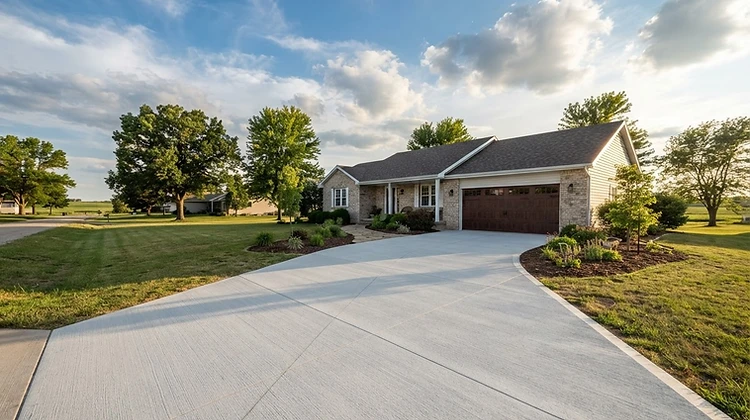
Straight talk
Concrete Driveways: what you should know first
Most driveway failures in Nebraska aren't concrete problems — they're base problems. Ground here holds water, freezes, heaves, and settles. If the slab is sitting on loose fill or skimmed topsoil, it cracks in the first year or two no matter how good the finish looked on day one.
So here's how we look at a driveway: the concrete is the easy part. The job is won or lost in what happens before the truck shows up.
Full transparency
How J Gehring builds it
Base first, always
We excavate to solid ground and run deep compaction on the subgrade — a full day of work before any concrete is ordered. That's the day your driveway earns its lifespan.
Rebar in every pour
Not wire mesh, not an upcharge. A rebar grid on chairs, held in the middle of the slab where it actually works.
Five inches minimum
Plenty of driveways around here got poured at four inches or less. Ours don't. Five inches carries pickups, campers, and the occasional loaded trailer without complaint.
Joints cut on schedule
Concrete is going to crack — the question is where. We saw the control joints at the right time, before the slab picks its own crack line.
Good fit
What it's good for
- Replacing a cracked or settled driveway
- New driveways on new construction
- Widening an existing drive or adding a parking pad
- Approaches and aprons
Honest pricing
What sets the price
- → Square footage — our minimum job is about 200 sq ft (roughly 10×20)
- → Tear-out and haul-off of an old driveway
- → How much base correction your ground needs
- → Thickness beyond five inches for heavy vehicles
- → Finish choice — broom is standard
- → Access for trucks and equipment
No number over the phone — Jerry walks your ground first, then the quote comes written and itemized.
Step by step
How the job runs
- 1
On-site estimate
Jerry walks your ground himself and gives you an honest read of what it needs — including whether your project should wait a season.
- 2
Written itemized quote + locked start date
You see exactly what you're paying for, and you get a start date in writing before work begins.
- 3
Pre-construction meeting
Before a tool comes out, we walk the plan together — layout, grades, access, and what to expect each day.
- 4
Base day: excavate + deep compaction
We spend the first day on the base. Deep subgrade compaction happens before any concrete is ordered.
- 5
Form, rebar, pour at 5"+
Forms set to grade, rebar in every pour — not an upcharge — and a minimum of five inches of concrete.
- 6
Joints cut on schedule + finish
Control joints get cut before the slab picks its own crack line, not days late. Then the finish you chose.
- 7
Final walk-around with you
Before the crew leaves, you and Jerry walk the whole job together. Questions answered on the spot.
Common questions